

Charter of Rights for the Sussex Ouse
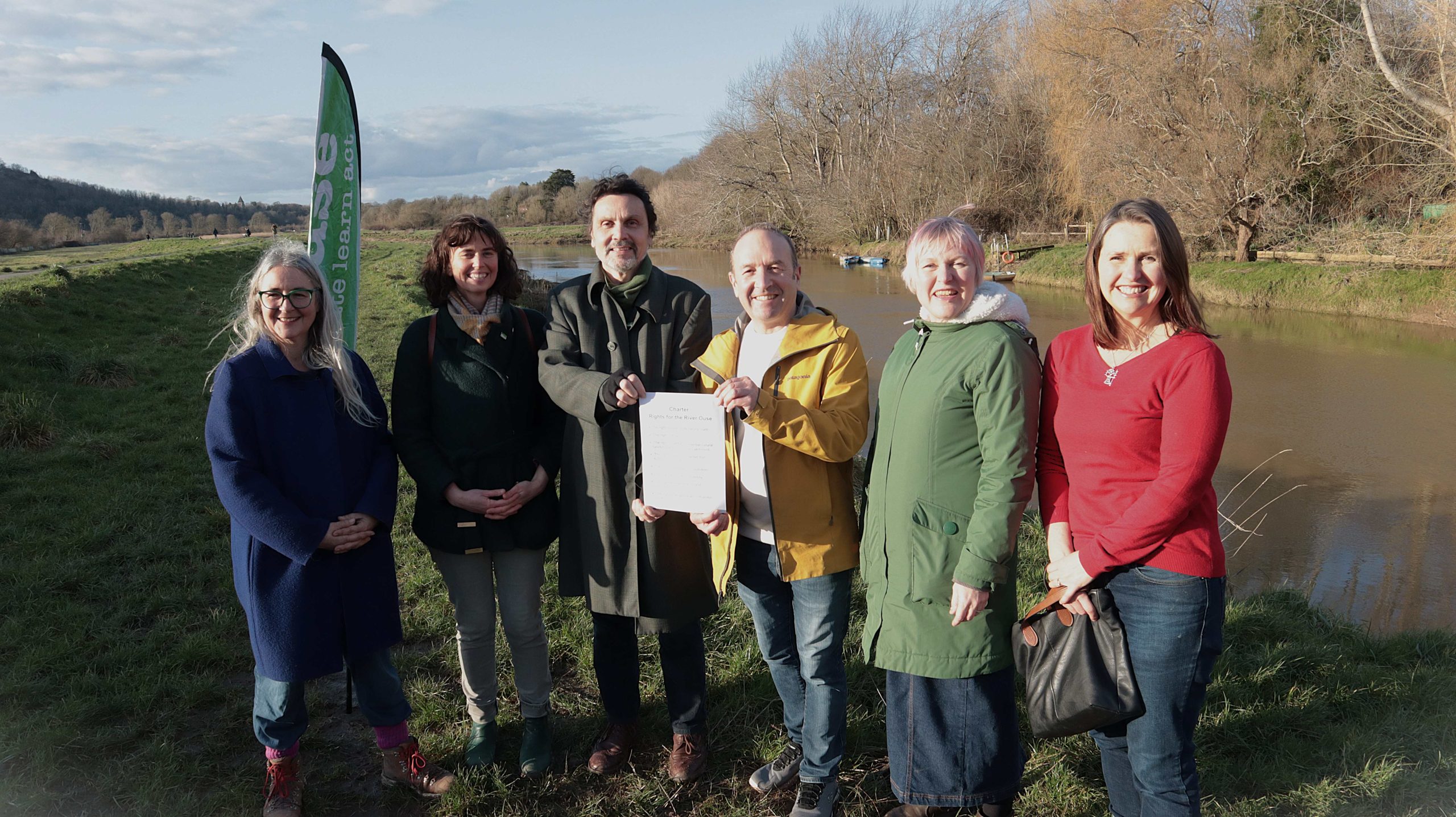
In February 2025, the River Ouse catchment became the first in the UK to have its rights to exist and thrive formally recognised by a local authority – Lewes District Council. Following this Wealden District Council, Lewes Town, Hamsey, Piddinghoe, Barcombe, Rodmell, Ringmer, Newhaven Town and Glynde & Beddingham Parish Councils have followed suit.
Love our Ouse led the two-year process of developing this charter of rights through public engagement activities, consultations and with key input from key local stakeholders as well as a range of experts including the Ouse and Adur Rivers Trust, Sussex Wildlife Trust, Railway Land Wildlife Trust and the Southwood Foundation.
This received widespread media attention not just in the UK, but globally. It represents a fundamental shift in the way we relate to and manage rivers: from being simply a resource to be exploited, to something of inestimable value and worth which we owe duties to.
Since then, other councils have emulated this approach for their own rivers and there are currently over thirty rivers in the UK pursuing charters of rights. As a result, we have been inundated with requests for technical support, media requests and research interest by academic institutions.
Furthermore, passing a charter is one thing. The challenge now is implementing the charter and proving that it can make tangible beneficial difference to the wellbeing of the river. This means raising greater awareness of the charter amongst the public and key stakeholders and strengthening the capacity of statutory authorities and other organisations to implement and uphold the charter. It also means developing appropriate governance mechanisms by which the voice of the river Ouse can be actively and influentially heard in decisions which affect it. We are working hard developing resources and onward plans learning from our journey to date.
We wholeheartedly thank everyone who has been part of this journey to date and we continue to build momentum and support.
River Ouse Charter ~
The River Ouse should possess the following fundamental rights as set forth in this Charter, which arise from its very existence.
● The right to exist in its natural state
● The right to flow
● The right to perform essential natural functions within the river catchment
● The right to feed and be fed from sustainable aquifers
● The right to be free from pollution
● The right to native biodiversity
● The right to regeneration and restoration
● The right to an active and influential voice
View the full Ouse Charter
View the Case for the Declaration of the Charter
Key links
Symposium: Exploring the practical application of the River Ouse Charter Read report HERE
River Summit Read Report HERE
Parish Council Workshop July 2026 Report and Presentation
Parish Council Draft Motion Template wording
Lewes District Council Motion on River Rights in February 2023
Lewes District Council Press release and Lewes District Council Lead Member decision on 24th February 2025
Our Full Press Release following the Lewes District decision
Wealden District Council Decision to support the Charter
Lewes Town Council meeting agenda and minutes
“The river is why Lewes became such an important town, yet for centuries it has been altered, polluted and neglected by us. By passing this motion, Lewes Town Council hopes to inspire other parish councils along the Ouse to support the Charter and recognise the rights of the river.”
Hamsey Parish Council meeting agenda and minutes
“By endorsing the River Ouse Charter, Hamsey Parish Council is recognising the river as a living system with fundamental rights, not simply an asset to be managed. The Ouse and its tributaries shape our landscape, our wildlife and our community identity. This endorsement commits us to working in partnership to protect and restore the river’s health for present and future generations.”
Piddinghoe Parish Council meeting agenda
“The village of Piddinghoe rests on the bank of the Ouse, barely two miles from the sea, so it makes sense for us to take an interest in matters concerning the river. Councillors had previously attended a workshop on the Charter where they were encouraged that it drew on specialist legal advice, and sought to be inclusive of the communities along the river, practical and proportionate. In our discussion about the Charter, the view was expressed that Nature Rights are very much of our time and that the Charter is a good example of how these might be pursued and merits our support.”
Barcombe Parish Council meeting agenda and minutes
“Barcombe Parish Council is really pleased to be supporting the Rights of the River charter. This is such an important initiative and hopefully the model will be replicated across the UK. We look forward to getting involved practically and working with different stakeholders to get our river back to where it should be – naturally clean and a haven for wildlife.”
Rodmell Parish Council agenda and minutes
“The River Ouse is an integral part of the Village identity: from our industrial and agricultural past to the beautiful natural landscape we all enjoy today. This constantly shifting body of water has shaped our landscape as we have in turn shaped the waterway. So, to have a document that sets out a clear frame of reference for existing in and alongside nature is an exciting and necessary addition to our community tool kit. We look forward to conversations and discussions on how to take on board the rights of the river for our wider community.”
Ringmer Parish Council agenda and minutes
“Ringmer Parish council are pleased to join the growing number of local councils adopting the Charter of Rights for the River Ouse. As a council, we recognise that our waterways are under severe pressure from climate change and inadequate infrastructure and must be safeguarded for future generations. Surface water flooding, inadequate reservoirs, and unacceptably high levels of sewage discharge from existing and proposed developments are major concerns, affecting the health of our water systems and the ecosystems they support.”
Newhaven Town Council agenda and minutes

What is Rights of Nature?
Rights of Nature is a way of rethinking our relationship with nature. All too often nature is defined in relation to humans and their activities. Rights of nature argues that nature should be recognised as existing on its own terms and have the same kind of legal rights that Human Rights give people. Rights of Nature also recognises the interdependencies that exists between all living things.
Some human rights have been extended to corporations globally – a company which is a wholly fictional entity is recognised as a legal entity distinct from its individual decision makers. If we can define a corporation as having rights, then it does not seem a great leap to suggest that nature and more specifically a river has similar rights.
The Universal Declaration on Rights of Rivers defines the basic rights for a river as;
- THE RIGHT TO FLOW
- THE RIGHT TO PERFORM ESSENTIAL FUNCTIONS WITHIN ITS ECOSYSTEM,
- THE RIGHT TO BE FREE FROM POLLUTION,
- THE RIGHT TO FEED AND BE FED BY SUSTAINABLE AQUIFERS,
- THE RIGHT TO NATIVE BIODIVERSITY, AND
- THE RIGHT TO REGENERATION AND RESTORATION
A Rights of Rivers declaration provides a framework to address the numerous threats faced by our river and broadens the narrow (but understandable) focus of the water pollution debate which dominates discussion on our waterways. We believe that to safeguard the future of our river and in fact all of nature we need the paradigm shift that Rights of Rivers brings.

Rights of Rivers across the UK
There is a fast growing recognition that Rights of Rivers offers an important shift in the way we relate to nature and rivers. The River Rights Network unified by a desire to see the rights of rivers become a reality and a UK Rights of Nature Network has been formed.
By the end of 2025
- 16 Councils have passed River Rights motions
- 40 more rivers have been exploring river rights approaches
- 1 Rights of Nature Bill submitted to the House of Lords

FAQ's
Here are more insights into the Rights of River and Nature movement that you may find useful
What is Rights of Rivers (Nature)?
There is a growing international movement that recognises nature as having rights, inherent to its own ecology, distinct and divisible from humans. The global context is of a growing area of earth jurisprudence; that is the law recognising that nature has rights, rivers, and forests for instance.
Who else has rights?
Recognising existing rights of nature is a natural evolution of the legal rights movement. Many peoples have fought to have their rights recognised over the centuries and now we have an International Declaration of Human Rights and the UK is a signatory to the European Convention on Human Rights.
Companies – a wholly fictitious entity have rights. A company exists as a separate legal entity, distinct from its decision makers, can be sued and can sue in a court of law.
What are key global dates for Rights of Nature?
In September 2008 Ecuador voted to accept a new constitution which included Rights of Nature. These rights are now embedded in the constitution and were enforced against the Ecuadorian government over mining concessions issued in a protected forest, Los Cedros in 2021. The court ruled they must be revoked. The Constitutional Court said the government’s failure to conduct studies looking at the fragility of Los Cedros coupled with the uncertainty of the effects from the permitted mining activity “violates the rights of nature to exist and regenerate”.
In 2017 the New Zealand Parliament voted to approve legislation recognising the Whanganui River as a legal person. “I am the river and the river is me” . S.12 of the legislation recognises “the river is an indivisible and living whole incorporating all its physical and metaphysical elements”.
On 19th December 2022, the United Nations (UN) Biodiversity Conference (COP 15) agreed a landmark agreement to halt and reverse biodiversity loss: the Kunming to Montreal Post-2020 Global Biodiversity Framework. It states: The framework recognizes and considers these diverse value systems and concepts, including, for those countries that recognize them, rights of nature and rights of Mother Earth, as being an integral part of its successful implementation.
How are Rights of Nature Implemented globally?
Environmental Constitutionalism, as with Ecuador’s constitution, rights of nature have been included in an overarching piece of legislation that gives constitutional effect to the protection and conservation of nature.
Legal Personhood as with the Whanganui River in New Zealand which grants natural entities legal personhood, this gives nature standing in court, but in addition gives courts a wider scope to take ecological science evidence into consideration in deciding on precaution and remediation.
Who speaks for the River?
Typically in the global movement nature and river rights are associated with indigenous communities, who already recognise nature rights through belief systems, cultural and moral values. In New Zealand the local Maori community are recognised in law as being able to give the river a voice. This is simply enshrining in law what the community have always recognised; that the Whanganui River is an ancestor.
Why are Rights of Rivers needed in the UK?
Nature is in crisis and as a species it is critical that humans reframe our relationship with nature, the UN has called for this. The UK is in one of the 10% most nature depleted countries in the world. Our rivers in the UK are in serious trouble with only 14% reaching good ecological status and no river reaching good chemical status.
Our environmental laws and regulations are failing to prevent the destruction of nature. Existing law is not being enforced and overarching legal environmental principles are marginalised. The existing regulatory structures for monitoring, management and enforcement of rivers are not fit for purpose.
Most of our laws are based around humans and their property, what they own and the protection of that which is owned. Our laws completely disregard the infinite numbers of species that we share the planet with.
Rights of rivers provides a new way of thinking about the natural world and provides legal mechanisms for reflecting the other, nature and non-human species.
Rights of Rivers in Lewes?
It is unlikely that we will have any overarching piece of UK legislation anytime soon, recognising rights of nature.
However there are opportunities at a local level. We will be exploring what opportunities may already be available such as under various Local Government Acts and the potential use of conservation covenants. Also we want to explore representational rights of the Ouse at forums such a planning meetings and in neighbourhood plans
Learn more about Rights of Nature & Rivers
Podcast – Advocating for Nature: Rights for the River Ouse listen: HERE
A rights of Nature Toolkit – rights-of-nature-toolkit.pdf
Ecoforensic CIC: Rights of Nature – www.youtube.com
Water has a memory – www.filmsforaction.org/watch/water-has-a-memory/
Cold Rights – https://susanschuppli.com/COLD-RIGHTS
Wildhope: Does Nature have Rights? – www.wildhope.tv/episode/does-nature-have-rights/
The Rights of Nature: A Legal Revolution That Could Save the World. Book by David R. Boyd
Wild Law: A Manifesto for Earth Justice. Book by Cormac Cullinan
Naturebang podcast – Rivers and Rights of Nature
Rights of Nature – a global movement documentary watch here
Invisible Hand – a Rights of Nature documentary
Useful Links
Rights for the River Ouse Press links
The Guardian – The River Ouse maybe the first River to Gain Legal Rights
Al Jazeera podcast – An English Town’s Take on Rights of Nature
Local Government – Granting Rivers Rights
Weald to Waves – Ouse Opens Floodgates for Legal Rivers Rights
The Telegraph – Why England’s most underrated river is about to become its cleanest
Sussex Wildlife Trust – Rights of River Charter
Sussex Express – Sussex River to be the first in England to have its own rights
The Argus – River Ouse could get legal protection after Lewes council motion
“We must begin thinking like a river if we are to leave a legacy of beauty and life for future generations.” - David Brower, Environmentalist
Contact Us
We’re keen to hear from anyone interested in being involved. Email us: info@loveourouse.org